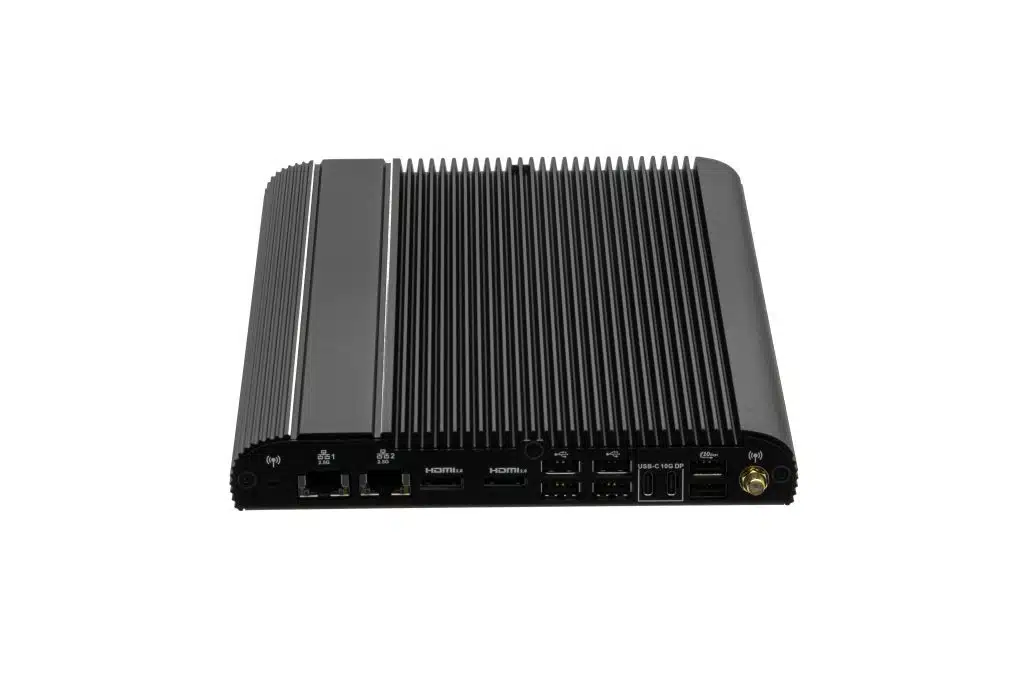
The BOX x7433 Eco from spo-comm offers a compact, fanless platform with industrial interfaces. This industrial PC really shines, especially when retrofitting existing systems.

Compact platform for retrofitting existing systems

A manufacturing company wants to digitally retrofit older production equipment without completely replacing the existing control systems. The goal is to centrally collect operational data—such as meter readings, machine statuses, and measurement values—and make it available to higher-level systems.

We are therefore looking for a compact computing platform that can be integrated into existing systems and communicate with the existing technology. At the same time, it should be suitable for industrial use and operate reliably even in confined spaces.

The Challenge: Integrating Existing Technology with New Systems

When modernizing established production environments, various requirements must be taken into account:

  • Compatibility: Existing devices and components should continue to be used wherever possible and integrated via appropriate interfaces.
  • Industrial connectivity: Serial interfaces and digital signals enable communication with compatible devices and components.
  • Space-saving integration: The additional computer hardware must be able to fit even in cramped control cabinets or plant areas.
  • Suitable for industrial environments: Temperature resistance and a robust design are important factors in selecting the hardware.
  • Cost-effectiveness: Retrofitting should enable a phased transition to digitalization without requiring a complete replacement of existing systems.

The Solution: BOX x7433 Eco for Industrial Data Collection

The BOX x7433 Eco from spo-comm is a compact local computing platform well-suited for these requirements. This fanless industrial PC combines an efficient Intel® Atom x7433RE platform with industrial interfaces and an extended operating temperature range.

The following features are particularly relevant for this application:

  • Intel® Atom x7433RE: This quad-core processor, with a clock speed of up to 3.40 GHz, provides an efficient foundation for suitable data acquisition and embedded applications.
  • Serial Interfaces: The COM port supports RS-232/422/485 and enables the connection of compatible legacy devices.
  • 4-bit GPIO: The GPIO port offers additional options for integrating suitable digital signals.
  • Dual LAN: Two Gigabit LAN ports enable network connectivity and offer flexibility when integrating into existing IT infrastructures.
  • Fanless design: The completely fanless design supports low-maintenance operation.
  • Extended Temperature Range: The BOX x7433 Eco is designed for operating temperatures ranging from −20 °C to +70 °C.

Implementation: Collecting and Sharing Operational Data

Once integrated into the system, the BOX x7433 Eco handles the local processing of the collected data. Compatible devices can be connected via the serial COM port, such as components that provide measurement values or meter readings via a supported serial interface. The GPIO port can also be used for suitable digital signals.

Appropriate software processes the incoming information and prepares it for further use. The data can then be transmitted to higher-level systems via the Gigabit LAN interfaces, such as to central monitoring software or a production data acquisition system.

Thanks to its compact dimensions of 120 × 80 × 52 mm, the BOX x7433 Eco can be integrated even in spaces with limited installation room. The fanless design and extended operating temperature range offer additional advantages for industrial installation environments.

Which specific devices can be connected and which data can be collected depends on the available interfaces, communication protocols, and the software used.

Conclusion: Targeted digitization of existing production facilities

The digitization of existing systems does not necessarily have to begin with a complete replacement of the existing technology. With a suitable computing platform, additional options for data collection and integration with higher-level IT systems can be created.

The BOX x7433 Eco offers a compact and cost-effective hardware platform for this purpose. The combination of serial interfaces, GPIO, dual LAN, and a fanless design makes it particularly well-suited for industrial data acquisition, machine retrofits, and embedded applications where existing technology is to be gradually integrated into modern system environments.

Compact Industrial PC for Demanding Environments

The BOX x7433 Eco stands out with its completely fanless design and compact dimensions of just 120 × 80 × 52 mm. This allows it to be integrated even into installations and systems with limited space. Since it relies on fanless cooling, the system is particularly well-suited for applications that require low-maintenance operation and low noise levels.

Another advantage is the extended operating temperature range from −20 °C to +70 °C. Combined with its specified vibration and shock resistance, the BOX x7433 Eco is designed for a variety of industrial environments.

Efficient Performance with Intel® Atom® x7433RE and DDR5

Inside the BOX x7433 Eco is the Intel® Atom® x7433RE, featuring four processor cores and a clock speed of up to 3.40 GHz. Combined with up to 16 GB of DDR5 memory, the industrial PC offers an efficient platform for standard industrial applications, decentralized control systems, and embedded solutions.

An M.2 2280 M-Key slot with PCIe Gen3 x2 is available for data storage. The integrated Intel® UHD Graphics enables video output via HDMI 2.0 at resolutions up to 4096 × 2160 pixels at 60 Hz. This makes the system suitable not only for traditional control tasks but also for industrial visualization and applications that require high-resolution displays.

Industrial Interfaces for Flexible Integration

The BOX x7433 Eco offers a versatile range of interfaces for connecting to machines, controllers, and other components. Two Gigabit LAN ports enable network connectivity, while a COM port with RS-232/422/485 support and a 4-bit GPIO facilitate integration into industrial environments.

In addition, USB ports for external peripherals and an M.2 2230 E-Key slot for expansion are available. This allows the compact industrial PC to be flexibly integrated into existing system environments.

A cost-effective solution for industrial control and embedded projects

Not every industrial application requires particularly high computing or graphics performance. Especially when it comes to standardized tasks, mass installations, and competitive bids, a balanced combination of functionality, compact design, and cost is often what matters most.

The BOX x7433 Eco offers a suitable platform for this purpose. Its industrial interfaces, fanless design, and compact form factor make it an attractive solution for cost-sensitive projects in the fields of industrial control, automation, edge computing, IoT, and data acquisition.

The highlights and technical data at a glance:

  • CPU: Intel® Atom® x7433RE, quad-core, up to 3.40 GHz
  • Graphics: Integrated Intel® UHD Graphics
  • RAM: 1× DDR5-4800 SO-DIMM, up to 16 GB
  • Storage: 1× M.2 2280 M-Key, PCIe Gen3 x2
  • Display: 1× HDMI 2.0, up to 4096 × 2160 @ 60 Hz
  • Network: 2× Gigabit LAN
  • Ports: 1× USB 3.2 Gen 2, 1× USB 3.2 Gen 1, 2× USB 2.0
  • Industrial interfaces: 1× COM RS-232/422/485, 1× 4-bit GPIO
  • Expansion: 1× M.2 2230 E-Key
  • Security: Onboard TPM 2.0
  • Cooling: Fanless
  • Operating temperature: −20 °C to +70 °C
  • Dimensions: 120 × 80 × 52 mm
  • Power Supply: 12 V DC / 48 W
  • Operating Systems: Windows 10 / 11 IoT, Ubuntu LTS Installation
  • Applications: Industrial Control, Automation, Embedded & Edge, IoT, Data Acquisition

With the BOX N150, spo-comm offers a compact industrial mini-PC designed specifically to meet these requirements. As the direct successor to the proven BOX J6412, the system combines the modern Intel® N150 platform with versatile connectivity and is particularly well-suited for standard industrial applications, machine visualization, and operator stations.

Compact Platform for Machines and Production Environments

A machine builder was looking for a compact and cost-effective hardware platform for the visualization and operation of its systems. The systems to be deployed were to be integrated directly into the respective machines and enable a reliable connection to displays, input devices, and the corporate network.

In particular, the challenge was to find a solution that could be easily integrated into existing machine designs even with limited installation space, while still providing sufficient performance for typical visualization and office applications.

The Challenge: Versatile Connections in a Small Space

Several requirements were crucial for the hardware used:

  • Compact design: Can be integrated directly into machines, control panels, or control cabinets without taking up much space
  • Adequate processing power: Reliable execution of visualization software, user interfaces, and standard applications
  • Versatile interfaces: Connection of displays, input devices, scanners, and other peripheral devices
  • Network connectivity: Reliable communication with machine controllers and higher-level IT systems
  • Cost-effective operation: Efficient hardware for high-volume production and decentralized machine installations

The Solution: BOX N150 for Industrial Visualization

The choice fell on the BOX N150 from spo-comm. This compact industrial PC combines a modern Intel® N150 platform with versatile features, making it particularly well-suited for traditional industrial applications.

Among other things, the following features were decisive:

  • Intel® N150 Processor: Four cores and up to 3.6 GHz provide ample performance for visualization and standard applications.
  • Up to 16 GB DDR5: The fast RAM provides ample capacity for a variety of software solutions and applications.
  • Five USB ports: Peripherals such as keyboards, mice, scanners, or touchscreens can be connected directly.
  • Dual LAN: Two Gigabit LAN ports enable flexible integration into existing network infrastructures.
  • Flexible display connectivity: Two HDMI 2.0 ports and DisplayPort via USB-C allow for the connection of multiple displays.
  • Compact design: The BOX N150 can be integrated even where space is limited.

The implementation

The BOX N150 has been integrated directly into the machine environment, where it serves as the central visualization and user interface.

The connected displays show, for example, machine statuses, production parameters, and process information. Operators can adjust settings and access relevant information via the touchscreen, keyboard, or other input devices.

The two Gigabit LAN ports enable communication with different network segments. At the same time, the numerous USB ports provide ample connectivity for peripheral devices.

Thanks to its compact design, the BOX N150 can be integrated directly into control panels or other space-saving installation areas. This facilitates the implementation of standardized hardware concepts across multiple machines and production lines.

Conclusion: Cost-effective hardware for traditional industrial applications

The BOX N150 provides a modern and compact platform for standard industrial applications. The combination of an Intel® N150 processor, DDR5 memory, and versatile connectivity makes this industrial mini-PC particularly well-suited for machine visualization, operator stations, and other decentralized applications in production.

As the successor to the BOX J6412, the BOX N150 offers a modern hardware platform for new projects and existing applications that require reliable performance, compact dimensions, and an attractive price-to-performance ratio.

Compact Embedded PC for Industrial, Kiosk, and Digital Signage Applications

The BOX N150 retains the proven compact form factor of its predecessor, making it particularly easy to integrate into existing installations. At the same time, the modern Intel® N150 platform offers enhanced CPU performance and provides a future-proof foundation for current operating systems and applications.

Whether as a control computer in industrial applications, a reliable platform for information terminals and kiosk systems, or a digital signage player—the BOX N150 is the ideal solution wherever compact dimensions, energy efficiency, and an attractive price-performance ratio are required. The system is also designed for 24/7 continuous operation, making it suitable for long-term production projects and rollouts.

Better Performance with the Modern Intel® N150 Platform

Inside the BOX N150 is the Intel® N150 processor, featuring four cores and a clock speed of up to 3.6 GHz. Compared to the previous generation, this modern platform offers increased computing power while maintaining low power consumption.

This makes the BOX N150 ideally suited for current applications and operating systems, and it is suitable for both new projects and replacing existing BOX J6412 installations. Up to 16 GB of DDR5 RAM ensures flexible configuration, while various M.2 interfaces enable a range of storage options.

5 USB ports and dual LAN for versatile applications

A key feature of the BOX N150 is its extensive connectivity. A total of five USB ports allow for the flexible connection of peripheral devices such as touchscreens, scanners, input devices, or other external components. The system is further enhanced by two Gigabit Ethernet ports, which enable reliable network connectivity and support, for example, the establishment of separate network connections.

The BOX N150 also offers versatile options for video output: Two HDMI 2.0 ports support 4K resolution at up to 60 Hz. DisplayPort via USB-C Alt Mode is also available. This allows the mini PC to be flexibly integrated into digital signage, kiosk, and visualization applications.

A Reliable Platform for Cost-Effective Projects

In addition to its compact design and modern hardware, the BOX N150 stands out above all for its well-rounded feature set. TPM 2.0 supports modern security requirements, while the power supply—via a 12- to 19-volt DC input—enables flexible integration into a variety of installations.

With Windows 10/11, Windows IoT, and Linux, a variety of operating system options are available for professional applications. This makes the BOX N150 particularly well-suited for cost-sensitive projects, competitive bids, and large-scale installations that require a reliable and modern industrial PC platform.

The BOX N150 is now available through spo-comm and can be customized and ordered.

The highlights and technical data at a glance:

  • CPU: Intel® N150 (quad-core, up to 3.6 GHz)
  • GPU: Intel® UHD Graphics (integrated)
  • RAM: 1× DDR5 SO-DIMM, up to 16 GB
  • Storage: M.2 PCIe 3.0 NVMe or M.2 SATA3 (2280) and M.2 A+E-Key PCIe 3.0 NVMe
  • Display Outputs: 2× HDMI 2.0 (4K @ 60 Hz), 1× DisplayPort via USB-C Alt Mode
  • Network: 2× Gigabit LAN
  • Ports: 5× USB, 1× COM (RS-232), 1× CTIA jack
  • Security: Onboard TPM 2.0
  • Power supply: DC-In (12–19 V)
  • Applications: Industrial, kiosk, digital signage, embedded & edge
  • Operating systems: Windows 10/11, Windows IoT, Linux

With the ONE N100, spo-comm offers a compact industrial PC designed specifically to meet these requirements—as the direct successor to the ONE J6412 and featuring a modern Intel® N100 CPU for enhanced performance in the entry-level segment.

Modern entry-level platform for industrial edge and visualization tasks

An industrial and infrastructure operator was looking for a compact, reliable, and energy-efficient hardware platform for decentralized IT tasks. The goal was to implement simple data processing and visualization processes directly on machines, systems, and digital information points.

The focus was on a robust system capable of reliably handling both traditional automation tasks and digital signage and edge-based applications in 24/7 operation.

The Challenge: Compact Computing Power for Decentralized Applications

The requirements for the hardware to be used were clearly defined:

  • Energy-Efficient Performance: Sufficient computing power for visualization, control, and simple edge tasks with low power consumption
  • 24/7 Operation in Industrial Environments: High Reliability for Continuous Use in Machinery and Infrastructure Applications
  • Limited installation space: Use in compact control cabinets, machines, or decentralized installation points
  • Easy system integration: Connection to existing networks, control systems, and display systems
  • Digital Signage Capability: Reliable playback and control of informational and promotional content

The Solution: ONE N100, a Compact Entry-Level Industrial PC

The choice fell on the ONE N100 from spo-comm—a fanless industrial PC designed specifically for compact and decentralized applications. The following features were decisive:

  1. Modern Intel® N100 CPU: Significantly more performance than its predecessor, the ONE J6412, while maintaining high energy efficiency
  2. Fanless design: Silent and maintenance-free operation for 24/7 continuous operation
  3. Ultra-compact design: Ideal for tight installation spaces directly on machines or behind displays
  4. Flexible connectivity: HDMI, DisplayPort, USB 3.2, Gigabit LAN, and built-in Wi-Fi
  5. Industrial-Grade Design: Reliable Operation in Automated and Decentralized Environments
ONE N100 compact industrial PC with low energy consumption for reliable continuous operation

The implementation

The ONE N100 has been used in various distributed scenarios, particularly in digital signage and industrial control applications.

In practice, the system handles the local processing of control and visualization tasks directly at the point of use. In digital signage environments, the compact industrial PC serves as a reliable player for informational and promotional content.

Thanks to its compact design, the ONE N100 can be flexibly integrated into existing infrastructures—whether directly on machines, behind displays, or in control cabinets.

Conclusion and Outlook for Compact Industrial and Edge Systems

The ONE N100 is a modern entry-level platform for industrial applications that combines a compact design, high energy efficiency, and enhanced computing power.

As the successor to the ONE J6412, the system provides a future-proof foundation for simple edge computing tasks, digital signage, and automation applications in 24/7 operation—exactly where reliable and space-saving industrial PCs are needed.

The company was looking for a compact industrial PC that could both visualize control room and monitoring data and serve as an edge platform for the local processing and distribution of system information.

The Challenge: Continuous Operation, Visualization, and System Density in the Control Room

The requirements for the new hardware were demanding:

  • 24/7 continuous operation: The systems must operate reliably around the clock, as outages in control centers are unacceptable.
  • Multi-display environments: Multiple monitors or video wall segments are to be controlled in parallel to display different data sources simultaneously.
  • Space-Constrained Integration: In control centers and control rooms, there is often only limited space available in consoles or equipment cabinets.
  • System Stability and Security: High standards for reliability, data availability, and stable network communication.

The Solution: WINDBOX III Core as a Compact Control Center Edge Controller

The choice fell on the WINDBOX III Core from spo-comm, a rugged, fanless industrial PC designed specifically for edge and visualization applications. The following features were decisive in selecting this system:

  1. Compact industrial design: The space-saving design allows for direct integration into control room consoles, equipment racks, or behind display units.
  1. Fanless design for 24/7 operation: Thanks to passive cooling, the system operates silently, without wear and tear, and with exceptional reliability—ideal for continuous operation in control rooms.
  1. High-Performance Visualization Platform: The modern x86 architecture enables the stable display of control room software, dashboards, and live data across multiple displays.
  1. Industrial Connectivity: Multiple network and interface options enable integration into control centers, security systems, and SCADA environments, as well as connectivity to central IT systems.

The implementation

The WINDBOX III Core was deployed as a central visualization and edge node within the control center infrastructure. It performs the following functions:

  • Controlling multi-display setups and video wall segments
  • the processing and aggregation of real-time data from various systems
  • the presentation of monitoring, control room, and control software
  • reliable network connectivity to higher-level control centers and IT systems

Local data processing has improved response times and reduced dependence on centralized server infrastructures.

Conclusion and Outlook for Control Center and Edge Applications

The WINDBOX III Core provides a compact, highly available platform for modern command and control center environments. The combination of a robust, fanless design, flexible connectivity, and stable multi-display support makes it ideal for safety-critical visualization applications.

Thanks to the standardized industry platform, future control center projects can be rolled out in a scalable manner and efficiently replicated at new locations.

Designed for demanding edge and industrial applications

In modern production environments, smart factories, and IoT infrastructures, data is increasingly processed directly at the point of use. The WINDBOX III Core was developed specifically to meet these requirements. The Intel® Core™ 5 120U processor from the latest Raptor Lake-P Refresh generation offers high computing power with a clock speed of up to 5.0 GHz, while consuming only 15 watts of power.

Combined with up to 96 GB of DDR5 RAM and fast NVMe SSDs, it delivers sufficient performance for data-intensive applications, visualization solutions, or the local processing of large amounts of data. At the same time, the fanless enclosure ensures maintenance-free and silent continuous operation—a decisive advantage in industrial environments.

Four displays, numerous interfaces, and maximum flexibility

Whether it’s digital signage, a control room, or machine visualization—the WINDBOX III Core supports the simultaneous operation of up to four independent displays via two HDMI and two DisplayPort outputs over USB-C. This allows information, dashboards, or advertising content to be flexibly displayed across multiple screens.

The system is also extremely versatile when it comes to interfaces. Two Intel® 2.5 Gigabit Ethernet ports enable fast network connections, while a total of ten USB ports and two freely configurable COM interfaces (RS-232/422/485) facilitate the connection of a wide variety of peripheral devices and machines. This makes the WINDBOX III Core suitable for both new industrial projects and integration into existing systems.

A future-proof platform with extensive expansion options

In addition to its high performance, the WINDBOX III Core stands out above all for its flexibility. Three M.2 slots allow for expansion with additional storage devices or communication modules. For example, the M.2 B-Key with a Nano-SIM holder can be used to add a cellular connection to the system, while the M.2 E-Key provides space for Wi-Fi or Bluetooth modules.

TPM 2.0 supports modern security requirements and protects sensitive data and system access. As a result, the WINDBOX III Core is suitable not only for traditional automation tasks, but also for edge computing solutions, AIoT applications, and connected smart factory concepts.

Dimensions of the WINDBOX III Core with its ultra-slim, fanless enclosure measuring 196 x 285 x 29 mm
Connection panel of the WINDBOX III Core with dual LAN, USB, HDMI, and COM ports

Compact design for reliable 24/7 operation

With a height of just 29 mm, the WINDBOX III Core is one of the most compact industrial PCs in its performance class. The rugged aluminum housing operates entirely without a fan and meets the shock and vibration resistance requirements of IEC 60068-2. This allows the system to be easily integrated into machines, control cabinets, kiosk systems, or directly behind displays.

Whether in industrial automation, mechanical engineering, smart retail, or digital signage—anywhere high performance, reliable continuous operation, and maximum connectivity are required, the WINDBOX III Core offers a future-proof platform.

The highlights and technical data at a glance:

  • CPU: Intel® Coreâ„¢ 5 120U (Raptor Lake-P Refresh, up to 5.0 GHz)
  • GPU: Intel® UHD Graphics
  • RAM: Up to 96 GB DDR5 (2× SO-DIMM)
  • Storage: 1× M.2 NVMe PCIe Gen4, 1× 2.5-inch SSD
  • Display outputs: 2× HDMI 2.0, 2× DisplayPort via USB-C
  • Network: 2× Intel® 2.5 Gigabit Ethernet; optional cellular connectivity via M.2 B-Key with Nano-SIM
  • Connectors:
  • 2× USB 3.2 Gen 2 Type-A
  • 2× USB 3.2 Gen 2 Type-C
  • 6× USB 2.0
  • 2× COM (RS-232/422/485)
  • Audio Line Out
  • Cooling: Passive, fanless
  • Power supply: 19V / 4.74A / 90W
  • Ambient temperature: -10°C to +50°C
  • Operating Systems: Windows 10 IoT Enterprise LTSC, Windows 11 IoT Enterprise LTSC, and Linux

Better Performance for Standard Industrial Applications

The Intel® N100 features four processor cores and reaches clock speeds of up to 3.4 GHz. Compared to the Intel® Celeron® J6412 used previously, users benefit from a noticeable performance boost—ideal for classic tasks in industrial automation, machine control, robotics, or digital signage.

The ONE N100 stays true to the proven design of its predecessor: The fanless design ensures silent and maintenance-free operation, while the compact metal case delivers reliable performance even during continuous 24/7 use.

Compact and versatile

Despite its dimensions of just 116 x 107 x 35 mm, the industrial PC offers all the key interfaces for industrial applications. These include four USB 3.2 ports, a freely configurable COM port (RS232/422/485), Gigabit Ethernet, as well as HDMI 2.0 and DisplayPort 1.4 for connecting displays. In addition, built-in Wi-Fi enables flexible network connectivity.

With 8 GB of DDR4 RAM and a 128 GB eMMC SSD, the ONE N100 is ideally equipped for typical control, visualization, and communication tasks in industrial environments.

Tried-and-true industrial PC—now with the latest CPU

The ONE N100 is designed for users looking for a compact, energy-efficient, and reliable industrial PC for standard applications. With the switch to the latest Intel® N100 platform, the system offers an attractive upgrade over the ONE J6412 and provides additional performance headroom while maintaining its familiar compact design.

The highlights and technical data at a glance:

  • CPU: Intel® N100 (4 cores, up to 3.4 GHz)
  • GPU: Intel® UHD Graphics
  • RAM: 8 GB DDR4 SO-DIMM
  • Storage: 128 GB eMMC SSD
  • Display outputs: 1× HDMI 2.0, 1× DisplayPort 1.4
  • Network: 1× Gigabit LAN, built-in Wi-Fi
  • Ports: 4× USB 3.2, 1× COM (RS232/422/485), Audio In/Out
  • Cooling: Passive, fanless
  • Power supply: 12V / 2A / 24W
  • Ambient temperature: 0°C to +40°C
  • Applications: Industrial automation, machine control, robotics, digital signage, industrial control
  • Operating Systems: Windows 10/11, Windows IoT, Linux

We show how the BRICK Ultra can be used as a compact edge computing platform in a networked industrial environment – from production and infrastructure monitoring to digital control centers.

Modern edge and AI computing platform for industrial applications

An international industrial and infrastructure operator was planning to modernize its decentralized IT structure. The aim was to process data from machines, sensors and cameras directly on site, carry out AI-based evaluations in real time and only transfer relevant results to central cloud and control systems.

The company was looking for a compact industrial PC that could reliably handle edge AI workloads as well as classic automation and visualization tasks.

The challenge: Decentralized intelligence under real operating conditions

The hardware requirements were varied and demanding:

  • Edge performance for AI applications: Local processing of image data, sensor information and key production figures in real time (Edge AI / Inference).
  • Industrial automation & stability: Use in machine and system environments with 24/7 operation and high reliability.
  • Limited space in decentralized installations: Installation directly on machines, in control cabinets or vehicle and infrastructure housings.
  • Network and system integration: Secure connection to SCADA, ERP and cloud systems with simultaneous data pre-processing at the edge.
  • Multi-display and control centre operation: Visualization of complex data situations in control rooms and monitoring systems.

The solution: BRICK Ultra as a compact edge AI and industrial platform

The choice fell on the BRICK Ultra from spo-comm, a particularly compact industrial PC that was specially developed for edge and embedded scenarios. The following features were decisive:

  1. Ultra-compact design: Ideal for decentralized installations directly on machines, in vehicles or in confined infrastructure spaces.
  1. AI-enabled CPU architecture: Supports modern AI workloads such as image processing, pattern recognition and edge inference directly on site – without permanent cloud dependency.
  1. Fanless, robust design: low-maintenance, vibration-resistant and suitable for 24/7 continuous operation in industrial environments.
  1. Flexible connectivity: Integration into industrial networks, machine control systems and higher-level IT systems thanks to extensive interfaces.
  1. Visualization capability: Suitable for multi-display applications in control stations and control rooms for real-time monitoring of complex systems.

The implementation

The BRICK Ultra was installed decentrally at machines, infrastructure nodes and control points.

In production, it was used for local processing of sensor data and AI-supported analysis of camera images for quality control. In traffic and infrastructure scenarios, it was used for real-time monitoring of operating states and events.

At the same time, the system acted as an edge gateway: pre-processed data was filtered and only relevant information was forwarded to central platforms and cloud systems. In control centres, aggregated data came together in multi-display setups to visualize critical states.

Conclusion and outlook for edge AI and industrial digitalization

The BRICK Ultra is a powerful edge computing platform that is specially designed to meet the requirements of modern industrial, transportation and infrastructure environments.

The combination of compact design, AI-capable computing power and industrial-grade robustness enables reliable use directly at the point of origin of the data – where real-time decisions are crucial.

The BRICK Ultra therefore forms a scalable basis for future edge AI architectures, from smart factories and networked infrastructures to intelligent control and monitoring systems.

AI performance for edge computing and modern industrial applications

At the heart of the BRICK Ultra is the Intel® Core™ Ultra 5 125U CPU, which offers integrated AI functionalities in addition to classic computing power. This makes the system ideal for applications such as AI-supported image processing, edge analytics or smart factory processes where data needs to be processed directly on site.

The modern architecture ensures high efficiency and strong performance at the same time. In combination with up to 96 GB DDR5 RAM and fast NVMe SSDs, the result is a platform that can reliably handle even demanding workloads.

Fanless high-performance industrial PC with flexible expandability

Despite its high performance, the BRICK Ultra is completely fanless and therefore noiseless and maintenance-free. This is particularly important for continuous 24/7 use in industrial environments or sensitive areas such as control stations and control rooms.

The system is also ideally positioned in terms of connectivity and expandability: With 2x LAN (1x 2.5 GbE + 1x GbE), a fast network basis is available. Additional functions such as 5G/LTE, WiFi or Bluetooth can be integrated via various M.2 slots. This is complemented by 4x USB 3.2 ports and two serial COM interfaces (RS232/422/485) for connecting machines and peripherals.

Robust design for industry, transportation and digital signage

The BRICK Ultra has been specially developed for use in demanding conditions. A wide range power input (12-24V), an extended temperature range of -10°C to +60°C and a vibration and shock-resistant design in accordance with IEC 61373 ensure reliable operation even in harsh environments.

At the same time, the dual DisplayPort with 4K resolution allows the industrial PC to be used in digital signage applications, control stations or monitoring systems. Thanks to DIN rail or wall mounting, the system can be flexibly integrated into a wide range of scenarios – from the production line to the edge server in the infrastructure.

Versatile thanks to modern interfaces and AI support

The combination of an AI-capable CPU, powerful hardware and industrial interfaces opens up numerous possible applications for the BRICK Ultra. These include automation solutions, IoT gateways, real-time data aggregation and intelligent monitoring systems.

Companies benefit from a future-proof platform that both meets current requirements and offers sufficient performance reserves for future applications.

The highlights and technical data at a glance:

  • CPU: Intel® Coreâ„¢ Ultra 5 125U (2x Performance Core, 10x Efficiency Core)
  • GPU: Intel® Graphics (integrated)
  • RAM: 2x SO-DDR5 RAM (up to 96 GB)
  • Storage: up to 2 TB NVMe
  • Max. Resolution: 4096 x 2304 @ 60Hz (4K)
  • Dimensions (H x W x D): 40 x 155 x 130 mm
  • Ambient conditions: -10°C to +60°C
  • Connectors:
    • 4x USB 3.2 Gen 2×1
    • 2x DisplayPort
    • 1x Gigabit LAN
    • 1x 2.5 Gbps LAN
    • 1x DIO (DB-9 male)
    • 2x COM RS-232/422/485
  • WiFi 6 & Bluetooth 5.2
  • Power Consumption (Idle): 12 W
  • Operating Systems: Windows 11 Professional, Windows 10 / 11 IoT Enterprise LTSC